When you buy through links on our articles, Future and its syndication partners may earn a commission.

The newly arrived and soon-to-depart crew members of Expedition 73 prepared for what is to come next during this, their final week all together aboard the International Space Station, Dec. 1-5, 2025.
Orbital observation
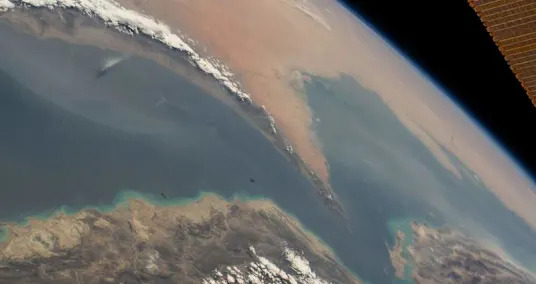
JAXA astronaut Kimiya Yui is fond of photographing his home nation of Japan from his vantage point aboard the International Space Station. Thursday (Dec. 4) was no different.
"Last night, I went to bed early and woke up once in the middle of the night to film a video of the Japanese archipelago," Yui posted to social media. "Even from space, it looked very cold."
"There were many areas where it seemed to be snowing or places where it had snowed afterward, and while it looked beautiful from space, I became a little worried when I thought about all of you," he wrote.
In the foreground are Northrop Grumman's Cygnus XL cargo ship, the S.S. William C. "Willie" McCool (at right) and the newly docked Soyuz MS-28 spacecraft.

Science status
Among the research that was conducted by the Expedition 73 crew aboard the space station this week was:
CIPHER — Zena Cardman and Jonny Kim of NASA collected samples of Cardman's blood, tested her cognition and measured her exercise, all as activities under the CIPHER human research study tracking astronauts' health before, during and after a spaceflight. Afterward, Cardman used a centrifuge to prepare them for being placed inside a science freezer for future analysis.
Astrobee — Scientists on Earth, working with astronauts on the space station like Kim, assessed robotic free-flying assistants called "Astrobee" to enable astronauts to conduct more research.
Station keeping
The Expedition 73 crew also devoted time to maintaining the space station's systems, including:
New Crew Member Orientation — Having just arrived at the space station the week before, NASA astronaut Chris Williams attended an orientation session, of sorts, as fellow NASA astronaut Mike Fincke and Kimiya Yui of JAXA took turns bringing Williams up to speed about life on orbit. Fincke and Yui familiarized Williams with space station hardware, operations and systems.
'Closet' inventory — Oleg Platonov, a flight engineer with the Russian space agency Roscosmos, spent the first part of his shift documenting the location and amount of clothing and towels remaining in the Russian segment of the space station.
Zero Boil-Off Tank Noncondensables — Flight Engineer Mike Fincke changed out the cameras inside a microgravity science glovebox to photograph how cryogenic fluids behave in microgravity to improve the design of spacecraft fuel tanks.
Astronaut activity

As part of their work maintaining the systems aboard the International Space Station, NASA astronauts Jonny Kim and Chris Williams spent this week cleaning and inspecting the European Exploration Exercise Device (E4D) after its installation in the European Space Agency's (ESA) Columbus laboratory.
According to NASA, the E4D is being tested for its ability to provide bicycling, rowing and resistance exercises to protect crew members' muscles, bones and heart health in microgravity.
By the numbers
As of Friday (Dec. 5), there are 10 people aboard the International Space Station: Expedition 73 commander Sergey Ryzhikov and Oleg Platonov, Sergey Kud-Sverchkov, Sergey Mikaev and Alexey Zubritsky of Roscosmos; NASA astronauts Zena Cardman, Mike Fincke, Jonny Kim and Chris Williams and JAXA (the Japan Aerospace Exploration Agency) astronaut Kimiya Yui, all flight engineers.
There are three docked crew spacecraft: SpaceX's Dragon "Endeavour" attached to the space-facing port of the Harmony module, Roscosmos' Soyuz MS-27 attached to the Earth-facing port of the Prichal node and Soyuz MS-28 attached to the Earth-facing port of the Rassvet module.
There are four cargo spacecraft: Roscosmos' Progress MS-31 (92P) docked to the space-facing port of the Poisk module, Progress MS-32 (93P) attached to the aft port of the Zvezda service module, Northrop Grumman's Cygnus XL, the S.S. William C. "Willie" McCool, berthed to the Earth-facing common berthing mechanism (CBM) on the Unity node and Japan's HTV-X1 attached to the Earth-facing CBM on the Harmony node.
As of Friday, the space station has been continuously crewed for 25 years, 1 month and 3 days.
LATEST POSTS
- 1
 Craig the beer-ambassador elephant dies aged 54
 - 2Pain at the pump for Hampton Roads residents
- 3Figure out How to Improve Your Stream Voyage with Remarkable Trips and Exercises
- 4Saudi Arabia says it intercepted 7 missiles, debris falls near energy facilities
- 55 Food varieties to Remember for Your Eating regimen for Ideal Wellbeing




- NASA probe captures stunning photos of Earth and moon on the way to infamous asteroid Apophis
- Kansas school officials report high student illness, dismiss early
- When is MLK Day? Plus, the dates of when other federal holidays land in 2026.
- Track down the Ideal Weight reduction Methodology for Your Way of life
- Internet goes (cocoa) nuts: The funniest reactions to 12 tonne theft of KitKat bars
- At least 490 protesters killed in Iran, activists say
- Share your pick for the miniature headphones that you generally suggest!
- Report: Thailand strikes deal with Iran for safe passage of Hormuz
- Who is behind Al-Majd, the Israeli-linked evacuation group sending Gazans to South Africa?